

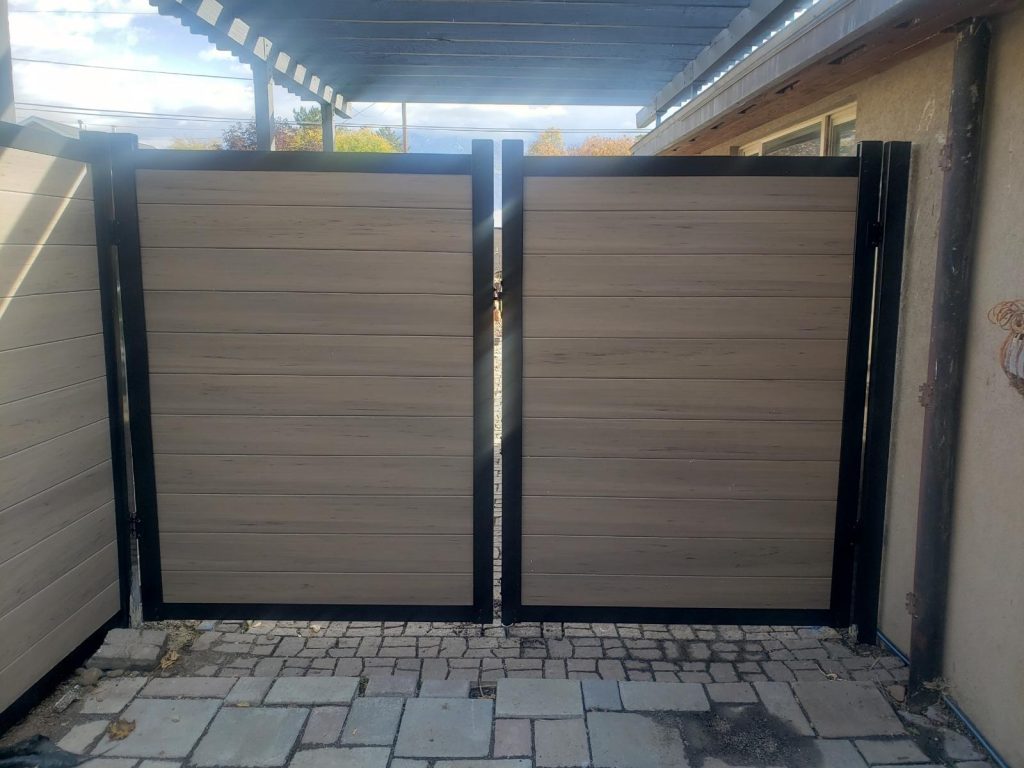
Commercial gates sag for three reasons: the frame was not welded square, the hinges were not rated for the gate’s weight and cycle count, or the posts settled. Shop-welded frames with reinforced hinge points and high-cycle adjustable hinges eliminate all three failure modes.
Gate callbacks are the most predictable warranty issue in the trade, and nearly all of them trace to a spec decision made before the crew ever reached the site.
Cause 1: Frame Geometry and Field Welding
A gate frame that is not square when it is built will never hang square, and field welding introduces variability that shop conditions eliminate.
On a jobsite, a frame gets assembled on uneven ground, often without a jig, by crews working at different skill levels. Small deviations in the corners compound across the diagonal, and the result is a gate that drags on one corner from the day it is hung.
Shop fabrication removes those variables. A custom welded gate frame built on a jig, in controlled conditions, arrives square and stays square. The crew hangs it rather than building it, which also cuts field labor hours.
Cause 2: Undersized Hardware for the Duty Cycle
The second failure mode is hardware rated for the wrong job. A commercial gate at a contractor yard or apartment community may cycle hundreds of times a day, and residential-grade hinges are not built for that.
When hardware is undersized, the failure is gradual and then obvious:
- Hinge pins wear and introduce play at the pivot
- Fasteners elongate their holes under repeated load
- The gate drops at the latch side until it no longer catches
Spec high-cycle adjustable hinges and commercial latches rated to the gate’s weight and expected cycle count. On double-gate openings, add drop rods so the inactive leaf carries its own load rather than transferring it through the latch.
Cause 3: Post Settling and Frost Movement
Even a perfect frame on correct hardware will fall out of alignment if the posts move. Utah’s freeze-thaw cycles lift and settle posts seasonally, and gate posts carry more load than line posts to begin with.
Two spec decisions address this. First, size and set gate posts for the gate’s weight and swing rather than to the same standard as line posts. Second, use adjustable hinges so the gate can be re-squared in minutes when a post shifts, instead of requiring a full re-hang.
That adjustability converts an annual callback into a five-minute service visit.
How to Spec a Gate That Stays Square
The gates that do not come back share the same specification pattern:
- Shop-welded frame built to the actual opening dimensions
- Reinforced hinge and latch points designed for the hardware being used
- High-cycle adjustable hinges matched to gate weight and traffic volume
- Drop rods or cane bolts on every double-gate opening
- Gate posts sized independently from line posts
- Frame and hardware ordered together so duty ratings match
Ordering the frame and the hardware as one package through wholesale gate fabrication is what keeps that matching intact. Mismatched components are usually discovered at hang time, when the schedule has no room left.
Tired of gate callbacks? Our fabrication shop builds custom welded gate frames to your openings, with hardware matched to the duty cycle.
Call (801) 566-4266 or send us a message.
Frequently Asked Questions
Why does my gate sag on one corner?
Most commonly the frame was not square when built, or the hinge is undersized for the gate’s weight and has developed play at the pivot.
Will adjustable hinges fix a sagging gate?
Adjustable hinges let you re-square a gate that has shifted from post settling. They will not correct a frame that was built out of square.
What hardware do double gates need?
Drop rods or cane bolts to stabilize the inactive leaf, plus latches and hinges rated for each leaf’s weight and cycle count.
Can you fabricate gate frames to my opening dimensions?
Yes. We fabricate custom welded gate frames in house to exact commercial and developer specifications, with reinforced hardware points.