

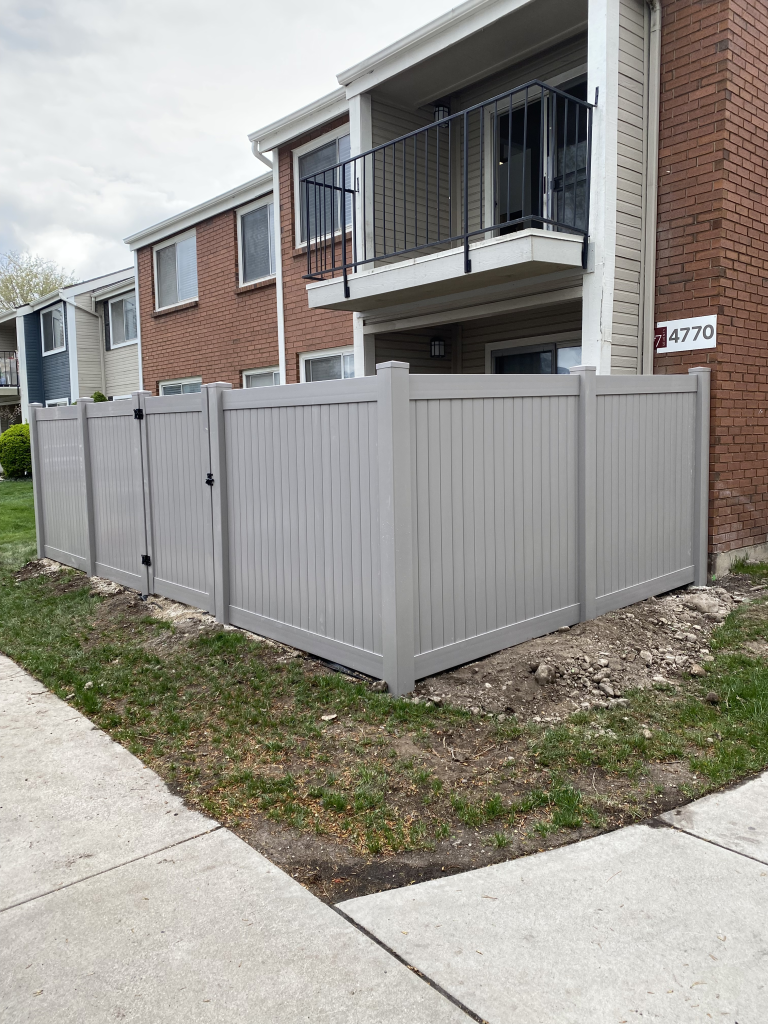
Aluminum wins on sightlines, security, and slope. Vinyl wins on privacy, install speed, and cost. For most Salt Lake Valley commercial perimeters, the deciding factor is not material quality, it’s whether the client needs to see through the fence or hide what is behind it.
When should you spec aluminum instead of vinyl?
Ornamental aluminum is the default for retail centers, apartment complexes, parks, and any site where security cameras need a clear line of sight. Rackable panels follow grade without stepping, which matters on the bench terrain running along the east side of the valley. Powder-coated aluminum will not rust where sprinkler overspray hits it every morning, and Utah’s alkaline soil is hard on untreated steel at the post base.
Vinyl is the default for privacy screening: dumpster enclosures, mechanical yards, RV storage, apartment perimeter buffers, and the backside of commercial lots that face residential neighbors. It goes up faster because panels arrive routed and ready, and it never needs paint.
Vinyl vs. aluminum fence: cost, labor, and performance compared
| Factor | Ornamental Aluminum | Commercial Vinyl |
| Material cost per foot | Higher | Lower |
| Install labor | Slower, more post setting precision | Faster, fewer components |
| Slope handling | Rackable, follows grade | Stepped or racked with limits |
| Privacy | None | Full |
| Maintenance | Powder coat lasts decades | Wash only |
| Wind load | Passes air through | Acts as a sail, needs engineering |
That last row decides more Utah jobs than anything else. A solid vinyl run in a canyon-mouth wind corridor near Draper, Bountiful, or the Point of the Mountain needs deeper posts, tighter post spacing, and often steel-reinforced rails. Aluminum sheds that load without the extra structure.
How do you spec a site that needs both materials?
Most commercial jobs are not one material. A common pattern: aluminum along the street frontage for curb appeal and visibility, vinyl along the shared property line for privacy, and a custom welded gate at the service entrance. Buying all three from one wholesale source keeps color, hardware, and delivery on a single schedule instead of three.
Our warehouse stocks both systems in West Jordan, so a contractor pricing a mixed perimeter can pull aluminum fencing supplier Utah inventory and high-volume vinyl fence supply off the same order and the same truck.
FAQs
Which lasts longer in Utah’s climate, vinyl or aluminum?
Both outlast wood by decades. Powder-coated aluminum holds up indefinitely with no UV concern. Quality vinyl with proper titanium dioxide UV inhibitors resists the chalking and yellowing that thin residential-grade panels show after a few high-altitude summers.
Can aluminum fences meet commercial security requirements?
Yes. Spec heavier picket walls, closer picket spacing, a flush-bottom rail, and pressed-point or spear tops. For higher-security sites, increase height and move to a welded rather than rackable panel.
Does vinyl fence hold up to Utah wind?
Commercial-grade vinyl does when it’s installed for the load. That means deeper footings, reduced post spacing, and steel or aluminum rail reinforcement in exposed corridors. Residential-grade panels installed at standard spacing are the ones that come down.
Which is faster to install?
Vinyl, in most cases. Fewer parts per section and no bracket assembly at each post.
Give us the linear footage and we will return a line-by-line comparison of both systems before your bid goes out.
Contact Fence Connection at (801) 566-4266 to price both systems against your takeoff.