

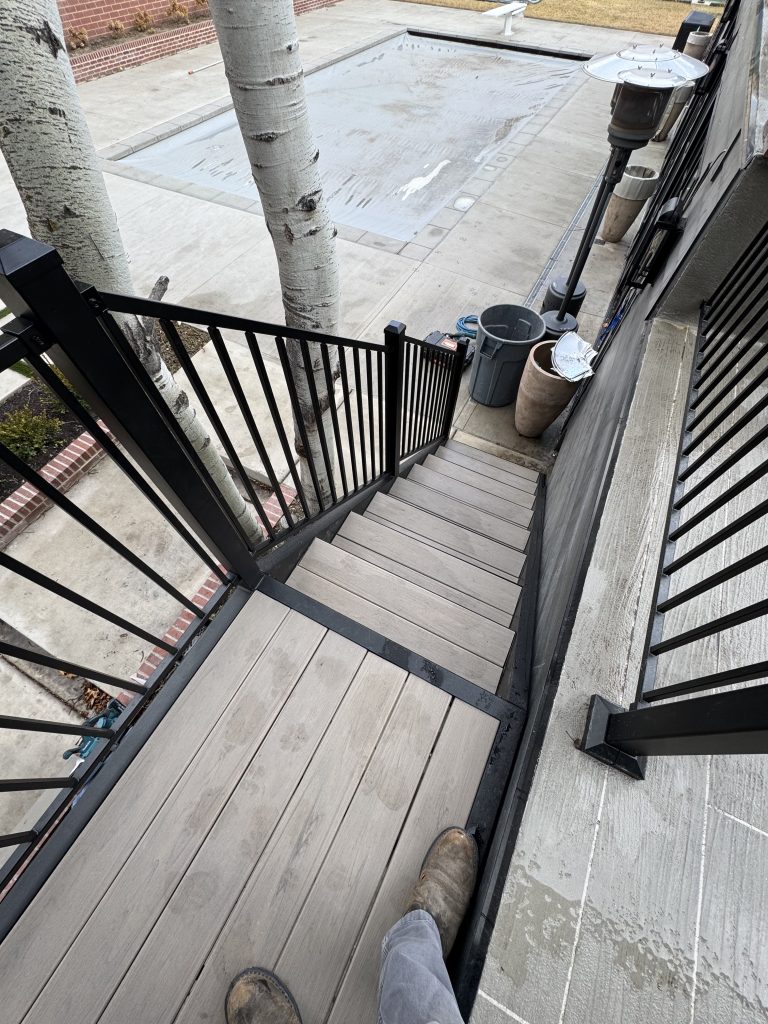
Aluminum handles longer spans, thinner sightlines, and higher guard loads. Vinyl costs less and matches vinyl fence lines. On a deck build, the guard has to pass inspection first and look right second, so start with the load requirement and work back.
What do deck guard codes require?
Deck guards are a life-safety element. Building officials across the Salt Lake Valley inspect guard height, opening limitations, and load resistance, and a guard that fails is a guard the crew rebuilds. Aluminum systems are typically engineered and tested as assemblies with documented load performance, which makes the inspection conversation shorter.
Vinyl railing systems pass when installed to the manufacturer’s spec, but that spec usually includes tighter post spacing and internal reinforcement. Ignore either and the assembly no longer performs the way the test did. Always confirm current requirements with the local building department for the jurisdiction you are permitting in.
How do aluminum and vinyl railing compare on span and labor?
Aluminum’s structural advantage means fewer posts across a run. That is a cleaner look off a deck facing the valley or the mountains, and it’s less post-setting labor for the crew. Powder-coated black aluminum has become the default on Utah decks for exactly this reason: it nearly disappears against a view.
Vinyl posts are larger and spaced closer, which reads heavier. On a deck where the railing is meant to match a white vinyl fence line in the yard, that is a feature rather than a flaw.
| Factor | Aluminum | Vinyl |
| Material cost | Higher | Lower |
| Post spacing | Wider spans | Closer, reinforced |
| Sightline | Thin, nearly disappears | Heavier, more visible |
| Install labor | Fewer posts and footings | More posts |
| Matches | Black metal fence lines | White vinyl fence lines |
Which railing costs less over the life of the deck?
Vinyl is lower cost per foot. Aluminum costs more up front and holds color and rigidity longer under UV load, which at Utah elevation is not a trivial difference. On a deck that also needs a gate at the stair or a transition into a fence line, aluminum’s rigidity simplifies the connection.
Both systems stock alongside deck board, so a builder pulling wholesale railing and balusters can put the guard, the posts, and the railing and deck inventory on one delivery instead of chasing components across three suppliers.
FAQs
Which railing is easier to install?
Aluminum, on most builds, because fewer posts mean fewer footings and connections. Vinyl components are lighter but require more posts and internal reinforcement.
Does vinyl railing sag?
Properly reinforced vinyl at the manufacturer’s specified post spacing holds line. Sag shows up when spacing is stretched or reinforcement is omitted.
Can I match aluminum railing to a vinyl fence?
Yes. Many builders run black aluminum guard on the deck and white vinyl fence in the yard deliberately, treating the deck as its own element.
Which holds up better to Utah sun and snow?
Powder-coated aluminum. It does not chalk, and snow load on a horizontal top rail is a non-issue for an engineered aluminum assembly.
Hand us the deck plan and we will return guard quantities, post counts, and both material options in one quote.
Contact Fence Connection at (801) 566-4266 for guard quantities and railing material options.